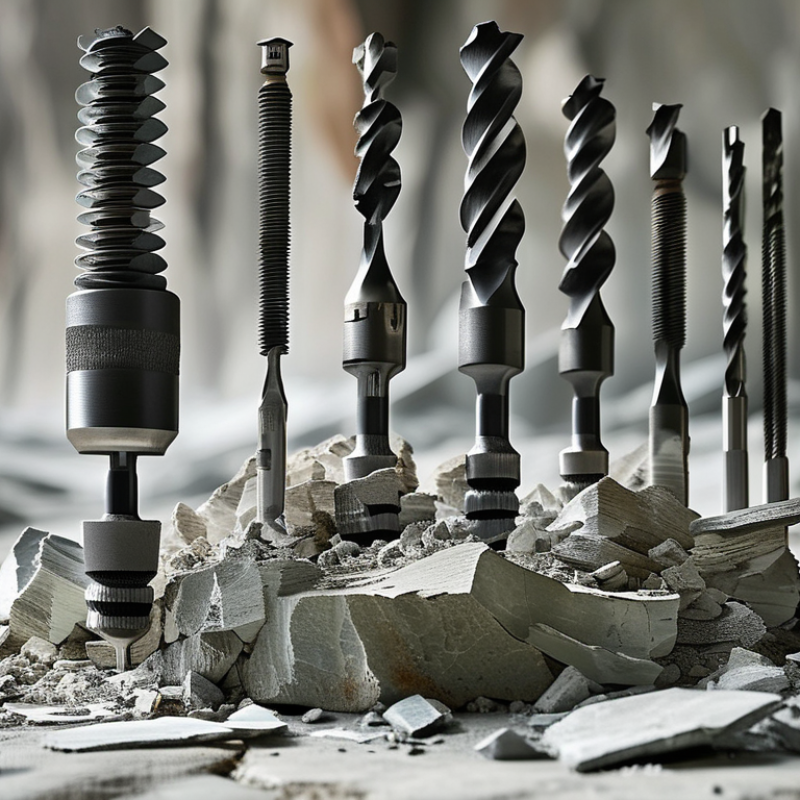
| DTH Button Bit | Medium-hard to very hard, competent rock; quarrying, mining, water wells, and construction drilling. | Approximately 90–350 mm | High penetration consistency in hard formations; hammer energy is delivered close to the bit face; generally produces straight holes when alignment and flushing are adequate. | Medium | Inspect carbide buttons and gauge wear regularly. Regrinding may be possible for some designs; replace the bit when buttons are excessively worn, cracked, or polished. | Choose it when hard-rock penetration, hole accuracy, and reliable flushing are more important than minimizing air consumption. |
| Top-Hammer Button Bit | Soft to hard rock; bench drilling, tunneling, bolting, quarrying, and short-to-medium hole drilling. | Approximately 25–152 mm | Efficient for relatively shallow holes and mobile drilling. Penetration can decline as hole depth increases because impact energy is transmitted through drill rods and couplings. | Low to Medium | Monitor button wear, gauge diameter, rod threads, and coupling condition. Keep threads clean and lubricated to reduce energy loss and premature failures. | Choose it for smaller holes, limited access, and operations where equipment mobility and lower initial tooling cost are priorities. |
| Tricone Roller-Cone Bit | Soft to hard formations; larger-diameter water wells, foundation drilling, oilfield-style rotary drilling, and general rotary applications. | Approximately 100–660 mm | Crushing, chipping, and scraping action adapts to a broad range of formations. Sealed-bearing designs reduce contamination, while open-bearing designs may tolerate selected conditions but require more care. | Medium to High | Inspect cutters, shirttails, nozzles, and bearing condition after each run. Bearing damage, broken teeth, and severe gauge wear normally require bit replacement rather than field repair. | Choose it when hole diameter is large, formation hardness varies, and a versatile rotary bit is needed. |
| PDC Fixed-Cutter Bit | Soft to medium-hard, relatively homogeneous formations; high-speed rotary drilling and applications requiring long intervals between trips. | Approximately 76–445 mm | Continuous shearing action can provide high penetration rates and smooth torque response in suitable formations. Performance may fall in highly abrasive, fractured, or interbedded rock. | High | Check cutter wear, impact damage, junk slots, and gauge pads. Some specialized cutters can be refurbished, but severe impact or thermal damage usually ends the bit run. | Choose it when the formation is compatible with shearing, drilling speed is critical, and the higher initial bit cost can be offset by longer footage per run. |
| Drag Bit | Soft, unconsolidated, clay-rich, or mildly abrasive formations; shallow water wells, geotechnical work, and soft-ground drilling. | Approximately 100–600 mm | Simple cutting structure and low mechanical complexity. Can drill quickly in soft ground but may ball up in sticky clay or suffer rapid wear in hard, abrasive rock. | Low | Clean cutting surfaces and fluid passages after use. Inspect wings and cutting edges for deformation; replacement is commonly more economical than extensive repair. | Choose it for soft formations where simplicity, low purchase cost, and easy replacement provide the best overall value. |
| Diamond Core Bit | Hard, abrasive, and fractured formations; mineral exploration, engineering investigation, and applications requiring a continuous rock core. | Commonly approximately 27–150 mm | Produces a core sample for geological or engineering analysis. Diamond exposure and matrix selection strongly affect penetration rate, core recovery, and bit life. | High | Track water flow, rotation speed, feed pressure, and diamond exposure. Avoid overheating and excessive pressure; reconditioning may be possible depending on the bit design. | Choose it when sample quality and core recovery are essential, even if the drilling system has a higher operating and tooling cost. |